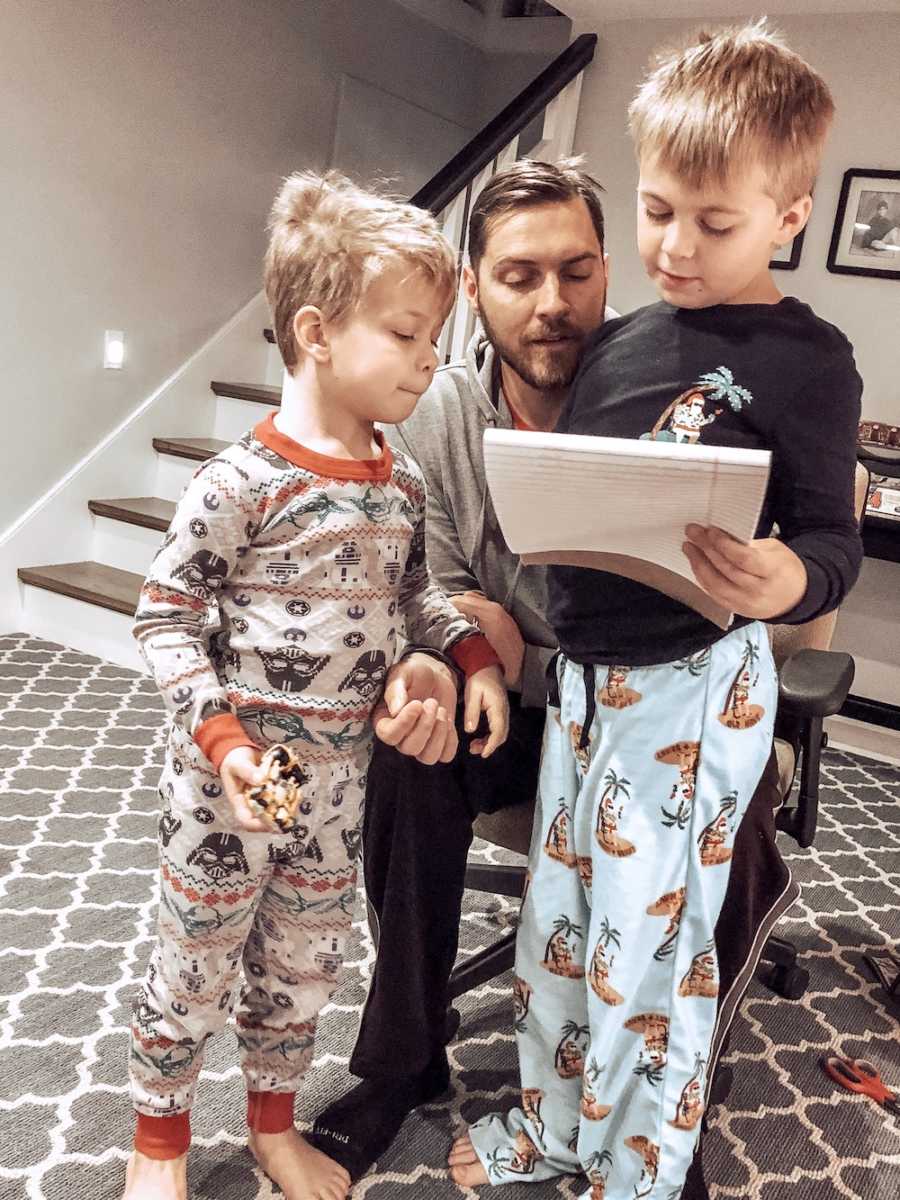
I remember when my husband and I first talked about having babies and raising children. The pictures I created in my mind were idyllic and oddly specific: a baby curled silently between us on the bed, sleeping peacefully while we competed against each other in Words With Friends (it was 2008, okay?). Or siblings happily entertaining themselves in the backyard while we sipped Arnold Palmers on the deck, casually flipping through the newspaper we were obviously mature enough to have delivered by then.
What those images didn’t include was me at 5:14 a.m., wildly un–camera ready, shushing my children from my bedroom while shouting things like, “IN THIS FAMILY, CHILDREN DO NOT GET UP BEFORE 6!” and jamming a small corner of my pillowcase into my ear for good measure.
But I think we can all agree that raising children rarely looks the way we imagine it.
I also think we can agree that raising children today feels infinitely harder than it did when our grandparents were parenting. Of course, the moms and dads of the 1950s and ’60s had their own challenges—hello, Cuba—but through my rose-colored glasses, parenting back then seems to have followed a simpler order of operations. A game of Checkers, if you will. Parents fed their kids, loved them, and moved them safely across the board, and in return, those children grew into decent, well-mannered adults.
King me.
Now, though, raising children has transmogrified—Calvin and Hobbes fans, you know—into a full-blown chess match against the world at large. Suddenly, everyone has opinions about how we should rear our offspring, and they aren’t shy about sharing them. Which brings me to Exhibit A:
The Excuse Note
If I were planning a spunky little family beach vacation in 1963, I imagine the school attendance secretary would be the last thing on my mind. Instead, I’d be focused on packing the perfect picnic basket (likely stuffed with roast beef sandwiches and Coca-Cola) and keeping an eye out for old-timey lifeguards armed with too much Brylcreem and not nearly enough sunscreen.
Today, if my family wants to sneak away for a few days of sun and sand, I must carefully craft an excuse note and essentially beg the elementary school staff not to call DCS.
Dear School Staff,
Please excuse my son for the next two days. He’ll be spending quality time with his family at the beach. I know, I KNOW—school rules and family drools—but just this once, couldn’t he stay home without a fever? I promise we’ll practice multiplication tables in the sand.
Sincerely,
A mom who already booked the condo
Thankfully, my high school years prepared me well for writing convincing excuse notes (sorry, Mom), so we haven’t crossed the truancy threshold just yet. But heaven forbid we play hooky to visit Santa before holiday break officially begins…
The Playgroup
I’ll be the first to admit that I don’t thrive in anything that ends with the word “group,” so forgive me if you’re someone who loves weekly gatherings of women and children in the same space. Still, when I was a new mom, I truly believed a playgroup would solve all my problems. Instant friends for my baby! Instant friends for me! Instant reason to take off my nighttime nursing bra and replace it with a daytime nursing bra!
Sadly, the playgroup experiment was a big, fat dud. The moms of toddlers wanted nothing to do with the moms of babies, and the moms of babies rarely showed up consistently. Since I already felt capable of managing awkward, surface-level relationships on my own—without a scheduled meeting—I struggled to invest real time (and sometimes money?) into the whole thing.
My Grandma Mim once told me that when her kids were little, if a girlfriend hadn’t shown up at your door by 10 a.m., you loaded all your kids into the car and went to her house. There were no sign-ups or fundraising efforts. You just showed up and were friends. You have kids? I have kids. I’m coming over.
Honestly, sign me up for that.
The Organic Section
I’ve heard that when our grandparents were raising kids, there was enormous pressure to put a Life Magazine–worthy dinner on the table every night. But I’m fairly certain I watched kids on Mad Men eat ham straight out of a can, so I’m guessing food-source guilt wasn’t really a thing back then.
I buy organic groceries almost entirely out of guilt. Guilt about my kids’ health. Guilt about the environment. Guilt when the cashier at Kroger gives me the side-eye because I have small children and a grocery bill under $200—clearly signaling I didn’t buy enough Annie’s snacks.
Don’t get me wrong—I think pesticides are bad. But I also think most organic produce grows about four inches away from non-organic produce, and I’m not entirely convinced it’s pesticide-free enough to justify the extra $100 a week. It all feels a little suspect.
And while I would love to sustain my family on the 4×6 raised garden bed in our suburban backyard, no one here can survive on cherry tomatoes and wilted greens alone. So I buy organic—most of the time—and feel proud of myself. That pride lasts until two days later, when I reach for the arugula and discover it’s brown, slimy, and completely inedible.
You win again, GMOs.
By the sacred laws of every good high school essay—thesis statement plus three supporting paragraphs—I’ve arrived at my conclusion. Raising children has never been easy, whether you did it in 1860, 1960, or 2019. Every generation faces its own set of challenges in this wild business called parenting.
But today, I’m under-caffeinated, my kids were up at 5:15 a.m., and for now… 2019 takes the cake.